


Is your rare Charizard currently buried under a mountain of common Energy cards? Many collectors find that as their stacks of ETBs and Booster Bundles grow, the joy of the hobby gets replaced by the stress of clutter. Learning how to organize a growing pokemon card collection is the difference between a messy pile of cardboard and a professional-grade archive. At PokeReaves, we know that a disorganized collection makes it impossible to track your progress or appreciate your rarest pulls.
You probably feel overwhelmed by the sheer volume of bulk cards and worried about the safety of your holos. It's a common struggle for everyone from casual fans to serious Swiss investors. This guide will show you how to build a scalable tiered system that protects your investment while making your hits look incredible. You'll learn the best methods for storing bulk, organizing sets like Scarlet & Violet-151, and managing everything from raw cards to your premium PSA 10 slabs.
Key Takeaways
- Learn to implement a tiered storage system that scales from 100 to 10,000 cards without increasing your workload.
- Discover the best sorting logic for your goals, whether you are completing Master Sets or mastering how to organize a growing pokemon card collection by rarity.
- Identify the essential protection supplies needed to safeguard your investment, from penny sleeves for bulk to premium portfolios for your "hits."
- Explore digital inventory tools and spreadsheet methods to track the market value and completion progress of your collection in real time.
- Understand the nuances of managing bilingual collections, a specific necessity for collectors in the Swiss market handling both English and French cards.
The Importance of Scalable Organization for Modern Collectors
Scalable organization is a system that functions with the same efficiency whether you own 100 cards or 10,000. It's the difference between a collection that grows with you and one that eventually collapses under its own weight. Many hobbyists face "collector fatigue" when their unorganized bulk becomes a source of stress rather than pride. Learning how to organize a growing pokemon card collection early ensures that your hobby remains manageable and rewarding. Since the debut of the Pokémon Trading Card Game in 1996, the sheer variety of sets has made a disciplined approach mandatory for anyone looking to maintain value.
Proper storage isn't just about aesthetics; it's about preserving "Gem Mint" potential. At PokeReaves, we've seen how even the rarest pulls can lose their luster if they aren't handled with care from the moment they leave the pack. A scalable system protects your investment from the environment and physical wear. This is especially vital if you plan on submitting your cards for grading in the future, as even microscopic imperfections can significantly impact a final score.
Why Order Matters in the Swiss TCG Market
The Swiss market presents unique challenges that require a tailored strategy. Collectors in Switzerland often manage bilingual collections, frequently mixing English releases with French Language Pokémon Booster Packs. This regional reality means your sorting logic must account for language barriers to keep your sets cohesive. Standards for card condition in the Swiss trading community are notoriously high, and maintaining a pristine collection is a point of pride for local enthusiasts. A Master Set is the ultimate goal for many specialized collectors, representing a 100% complete archive of every card, variant, and secret rare within a specific expansion.
The Financial Risk of Chaotic Storage
Storing cards loosely is a financial gamble you'll likely lose. Surface scratches caused by "box rubbing" occur when cards shift against each other in substandard containers. This minor friction can easily drop a card's grade from a PSA 10 to a PSA 7, potentially stripping away hundreds of CHF in market value. Beyond physical damage, disorganization creates a significant time-cost. Searching through unlabeled boxes for a specific card to trade or sell is inefficient and frustrating. A structured system also prevents the "duplicate trap," where collectors accidentally purchase expensive singles they already own but simply can't find. Investing in quality storage today saves you from these hidden costs tomorrow.
Choosing Your Sorting Logic: Sets, Rarity, or National Dex
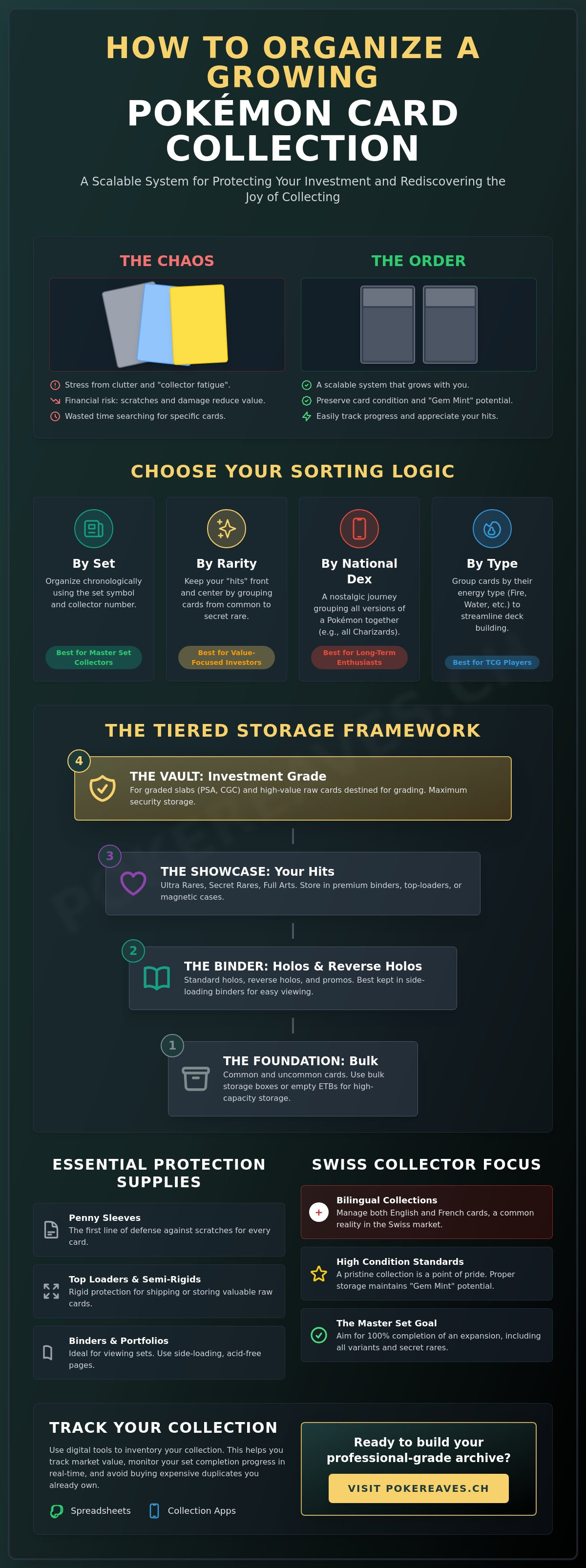
Before you crack open another Elite Trainer Box, you need a plan. Choosing the right sorting logic is the foundation of how to organize a growing pokemon card collection effectively. Most collectors gravitate toward one of four primary methods, each offering a different way to experience the hobby. Sorting by set is the gold standard for those chasing a Master Set, such as the iconic Scarlet & Violet-151. If you prefer seeing your best pulls immediately, sorting by rarity keeps your "hits" front and center. Players often prefer sorting by Pokémon type to streamline deck building, while long-term enthusiasts might choose the National Dex method for a cross-generational journey. Your logic should reflect your specific goals as a Swiss collector, whether you're focused on investment or playability.
The National Dex method is particularly nostalgic. It involves placing every Bulbasaur together, followed by every Ivysaur, regardless of the set they came from. This is a massive undertaking for a growing collection, but it's incredibly rewarding for those who have a favorite Pokémon they've tracked for decades. Conversely, sorting by type is ideal for "Charizard hunters" or "Mew collectors" who want to see their elemental themes grouped together in a single, cohesive display. No matter which path you choose, consistency is the key to maintaining an organized archive that doesn't become a chore to manage.
Mastering the Set-Based Organization
This method relies on the set symbol and collector number found at the bottom of every card. It's the most professional way to maintain a chronological archive. In a set-based binder, you'll group standard cards first, followed by Secret Rares and Special Illustration Rares. To stay motivated, use "placeholder" slots. Inserting a blank card or a sticky note for missing entries allows you to visualize your progress toward completion. It's a satisfying way to track your hunt for that final rare piece to finish your set.
Sorting by Rarity and Value
Not every card belongs in a standard box. A dedicated "Hit Binder" is essential for Ultra Rares, Special Illustration Rares, and Gold cards. This keeps your most valuable assets separated from standard holos and reverse holos. High-value cards often represent a significant portion of your collection's worth. According to data regarding the most valuable Pokémon TCG cards, certain pulls can reach thousands of CHF in the right condition. For these grails, a binder slot might not be enough. You may need to transition them to individual toploaders or semi-rigids to ensure they stay in Gem Mint condition. If you want to start a new set and test your luck, you can find the latest Prismatic Evolutions Booster Bundles to hunt for your next big hit.
The Tiered Storage Framework: From Bulk Boxes to PSA Slabs
A successful collector doesn't treat a common Weedle the same way they treat a Special Illustration Rare Charizard. Building a tiered framework is the most effective method for how to organize a growing pokemon card collection without losing your mind. This system categorizes your cards into four distinct levels based on their rarity, condition, and market value. By separating your "chaff" from your "grails," you ensure that your resources are spent on protecting the cards that actually matter for your long-term investment.
Tier 1 is dedicated to bulk storage. This includes common and uncommon cards that usually reside in BCW cardboard boxes or empty ETB boxes. Tier 2 focuses on your play sets and standard holos, which belong in high-quality side-loading binders for easy viewing. Tier 3, often called "The Vault," is for high-value raw singles that require individual toploaders or semi-rigid holders. Finally, Tier 4 represents the pinnacle of your collection: PSA graded cards Switzerland collectors prize for their authenticity and preserved condition.
Managing the "Bulk" Problem
Opening a new Scarlet & Violet-151 Elite Trainer Box is a thrill, but it leaves you with dozens of duplicate commons. The secret to managing bulk is sorting immediately after your pack opening session. Use plastic or cardboard dividers to separate sets within large storage boxes so you aren't digging through 5,000 cards to find a specific trainer. When your bulk boxes get too heavy, consider "culling" your collection. Many collectors sell or trade bulk in quantities of 1,000 or more to local Swiss shops to fund their next purchase of Prismatic Evolutions Booster Bundles. This keeps your physical space manageable and your hobby budget healthy.
Displaying and Protecting Your Grails
Your "hits" deserve better than a shoebox. Side-loading binders are superior to traditional ring binders because they eliminate "ring damage," where the metal rings leave indentations on the cards closest to the center. They also prevent "page sag," keeping your cards flat and secure over time. For your Tier 3 raw cards, double-sleeving is a mandatory practice. Place the card in a "perfect fit" sleeve upside down, then into a standard deck protector right-side up. This creates a seal that protects against dust and moisture. This level of care is what keeps a card in contention for a Gem Mint 10 grade, ensuring your collection remains a premium asset for years to come.
Essential Protection Supplies for the Growing Collection
Choosing the right materials is the most critical step in how to organize a growing pokemon card collection. Your storage system is only as good as the physical barriers protecting your cards from humidity, dust, and physical friction. For Swiss collectors, chemical safety is non-negotiable. You must ensure all plastics are PVC-free and acid-free to prevent the ink from bonding to the sleeve over time. High-quality protection keeps your "hits" in pristine condition, ensuring they retain their value for years. As your collection expands, moving beyond the traditional shoebox to specialized TCG luggage or heavy-duty cases becomes a necessity for both safety and portability.
Standard protection begins with a variety of sleeve types. Penny sleeves are loose and ideal for bulk, while deck protectors offer a sturdier feel for cards you handle frequently. Perfect fits are designed to hug the card tightly, providing an extra layer of defense when used inside a larger sleeve or binder pocket. For long-term raw storage, toploaders remain the industry standard. They provide a rigid exterior that prevents bending. When you're ready to transport your collection or store it in a high-density format, look for cases that offer reinforced corners and secure latching mechanisms.
The Anatomy of a Protected Card
Properly double-sleeving a card is an art that prevents edge wear and surface scratches. First, slide the card into a "Perfect Fit" sleeve from the top down. Perfect Fit sleeves must be inserted upside down to create a dust-proof seal when placed into the second, larger sleeve. Next, slide that assembly into a standard deck protector or a side-loading binder page. This creates an airtight pocket that guards against environmental damage. While toploaders are great for home storage, you should switch to a Card Saver 1 if you're preparing a submission for grading, as these semi-rigid holders are the preferred choice for major grading companies.
Sourcing Quality Supplies in Switzerland
The quality of your supplies matters as much as the cards themselves. It's vital to buy from a trusted tcg shop schweiz to avoid counterfeit plastics that might contain harmful chemicals. You don't always need to buy external boxes for every set; you can use empty Scarlet & Violet-151 Elite Trainer Boxes as high-quality themed storage for your bulk or play sets. These boxes are built to last and fit sleeved cards perfectly. For any items you plan to display on a shelf, always prioritize UV-resistant cases to prevent the Swiss sun from fading the vibrant colors of your favorite artworks. To ensure your collection stays in Gem Mint condition, browse our premium protection supplies today.
Maintaining Your Collection: Inventory and Value Tracking
Creating a physical system is only half the battle. To truly master how to organize a growing pokemon card collection, you must implement a digital tracking strategy. High-demand releases move quickly in the Swiss market, and keeping a real-time log of your assets ensures you never lose track of your portfolio's value. A professional inventory should include both your raw singles and your sealed products, such as Elite Trainer Boxes or special collections. Whether you're a casual fan or a serious investor, knowing exactly what you own prevents duplicate spending and helps you identify which sets are nearing completion.
Your inventory should undergo a periodic audit every 6 months. This is the perfect time to re-evaluate your cards and move them between the tiers discussed earlier. Perhaps a card you previously considered "bulk" has spiked in value and now deserves a spot in your "Hit Binder" or a toploader. During these audits, you can seamlessly integrate new additions from Prismatic Evolutions Booster Bundles or other recent expansions into your established folders. Keeping your data current is what separates a hobbyist from a disciplined collector.
Digital vs. Physical Inventory
Mobile apps like TCGplayer, PriceCharting, or Collectr are indispensable for quick value checks at Swiss trade events. They allow you to scan cards instantly and see market prices in CHF, which is vital for fair trading. However, digital tools have limitations with sealed products or rare French-language variants. For maximum control, many advanced collectors maintain a custom Google Sheet alongside their apps. This spreadsheet should track the "Condition" of every high-value card, from Near Mint to Played, and include "Price Alerts" for specific singles you need to finish a Master Set. This hybrid approach gives you the mobility of an app with the granular detail of a private database.
The "One In, One Out" Rule for Growing Collections
As your collection expands, physical space often becomes a premium. To prevent your hobby from taking over your living area, adopt the "One In, One Out" rule. This strategy focuses on consolidating value rather than just accumulating volume. For every new box you add, look for opportunities to "cull" your lower-tier cards. Trading 100 bulk commons for a single high-value Illustration Rare is a smart way to increase the overall quality of your archive without increasing its footprint. Organization is a continuous journey that evolves alongside the TCG itself. Keep the process fun, stay disciplined with your tracking, and remember that PokeReaves is always here to support your passion for the game.
Build Your Professional Archive Today
You've learned how a tiered storage framework protects your investment and why consistent digital tracking is vital for market awareness. Mastering how to organize a growing pokemon card collection ensures your hobby remains a source of joy rather than a storage headache. By implementing these scalable systems, you preserve the Gem Mint quality of your cards and make your best pulls easy to find and display. A well-ordered collection is a reflection of your passion and a safeguard for your financial assets.
As you refine your system, you'll need the right products to fill those empty binder slots and storage boxes. At PokeReaves, we are proud to offer our family-run Swiss TCG expertise to help you succeed. We specialize in high-demand releases like Scarlet & Violet-151 and premium PSA 10 Graded Cards. You can also enjoy free shipping on all orders over 350 CHF within Switzerland. Explore the latest Sealed Products and Graded Cards at PokeReaves and take the next step in your collecting journey. Keep hunting those grails and building an archive you're proud to showcase.
Frequently Asked Questions
What is the best way to store Pokémon cards for long-term value?
The best way to store cards for long-term value is a tiered system using acid-free and PVC-free materials. Double-sleeving your top hits with a "Perfect Fit" and a standard protector is the gold standard for preservation. This prevents moisture and dust from reaching the card surface. For your most valuable assets, using a UV-resistant case or a high-quality side-loading binder ensures the card remains in Gem Mint condition for future grading.
Is it better to keep Pokémon cards in a binder or a box?
Use side-loading binders for your "hits" and sturdy cardboard boxes for your bulk. Binders provide immediate visibility and better protection against physical friction for rare cards. However, boxes are the only practical solution for how to organize a growing pokemon card collection when you have thousands of common cards. Using empty ETB boxes or BCW containers keeps your space tidy while ensuring your bulk stays flat and out of direct sunlight.
How do I organize my bulk Pokémon cards quickly?
Sort your cards immediately after opening a new Scarlet & Violet-151 Elite Trainer Box to avoid a backlog. Use labeled dividers to separate cards by set name or rarity within large storage boxes. This method allows you to find specific trainers or energy cards in seconds. If your bulk exceeds 2,000 cards, consider culling the collection by trading them in to fund your next premium purchase of sealed product.
Can I use a regular 3-ring binder for my Pokémon collection?
You should avoid using regular 3-ring binders because they often cause permanent "ring damage" to your cards. As the pages shift, the metal rings can leave indentations on the innermost cards. Instead, invest in dedicated TCG portfolios with fixed, side-loading pages. These are designed specifically to prevent "page sag" and keep your collection secure even when the binder is stored upright on a shelf for years.
Should I sleeve every Pokémon card I pull?
You don't need to sleeve every card; focus your resources on holos, reverse holos, and ultra rares. Sleeving every common card in a 5,000-card collection adds unnecessary bulk and expense. Use penny sleeves for standard holos and reserve your premium deck protectors for "hits." This selective approach makes it much easier to manage how to organize a growing pokemon card collection without overspending on plastic supplies or storage space.
How do I know which Pokémon cards are worth keeping in a binder?
Keep any card with a rarity symbol higher than a single "diamond" or "circle" in your binder. Illustration Rares, Gold cards, and Special Illustration Rares are always worth the extra protection of a portfolio. Use an app like TCGplayer to check current market values; any card worth more than 5 CHF should generally be moved from a bulk box into a protected binder slot to prevent accidental surface scratches.
What is the safest way to store PSA graded cards?
Store your PSA graded cards in specialized slab cases or dedicated slab binders to prevent the acrylic from scratching. These cases often feature foam inserts that hold the slabs securely during transport or storage. Keep your graded collection in a climate-controlled environment with low humidity. For display, use UV-resistant stands to ensure the label and the card don't fade under the Swiss sun over time.
How do I organize a bilingual (French and English) Pokémon collection?
Swiss collectors should organize bilingual collections by separating English and French cards into dedicated sections within their binders. You can use colored dividers or specific "Language" tabs to distinguish between the two regional releases. This is particularly helpful when completing Master Sets, as it prevents confusion between different releases. Keeping your French Language Pokémon Booster Packs sorted separately ensures your collection remains professional and easy to navigate.


